Honours in the 28 Card Game, Explained
If you have played 28 you have heard people say "Honours". It is a simple idea with two effects.
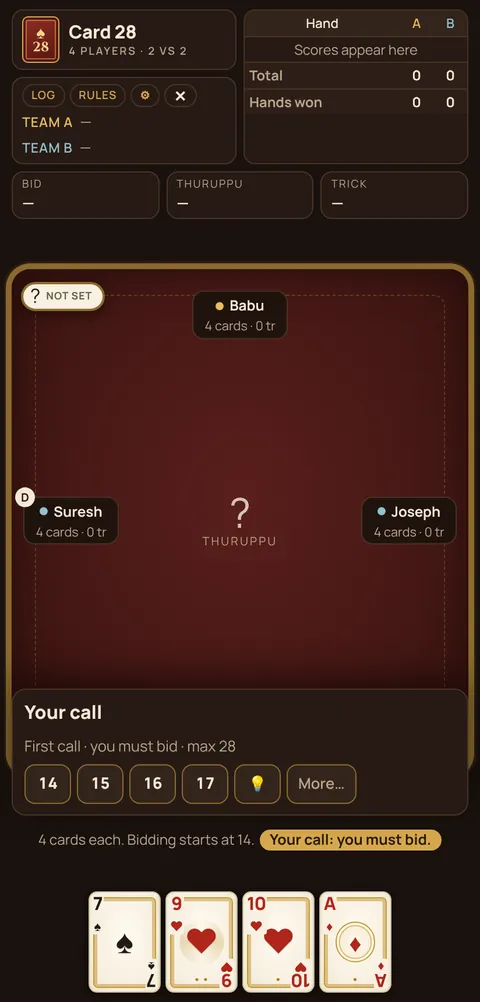
What is Honours?
In the rules used on Cheettukali, a bid of 20 or more is called Honours.
Effect 1: you can bid over your partner
Normally you may not outbid your own partner. If your partner has the bid and your left-hand opponent has passed, you may raise only if you bid at least 20. This exists so that you cannot overbid your partner for no reason, but you can still take over when your hand is really strong.
Effect 2: bigger score
| Bid | Made | Failed |
|---|---|---|
| Up to 19 | +1 | −2 |
| 20 to 24 (Honours) | +2 | −3 |
| 25 and above | +3 | −4 |
A bid of 20 doubles the reward but costs one more point if you fail.
When is Honours worth it?
- You hold the Jack and the 9 of the same suit, plus an Ace or 10.
- Your partner's bidding shows strength in another suit, so you expect to share the points.
- Your opponents have passed quickly, which suggests weak hands.
When to avoid it
With only one strong card, 20 is too high. Remember that there are only 28 points in the pack, and your team must collect 20 of them.
House rules differ from place to place. Check the 28 rules and agree on the scoring before you start.
🃏 Try it now: play 28 free in your browser, no download, no money.
FAQ
What does Honours mean in 28?
A bid of 20 or more.
Can I bid over my partner in 28?
Only with Honours (20 or more) when your left-hand opponent has passed.
Is Honours the same in every region?
No. Rules differ between groups, so confirm the rules first.