Indian Rummy Rules (13 Cards)
Indian Rummy is a 13-card rummy game for two to six players. Arrange your cards into valid groups and be the first to show.
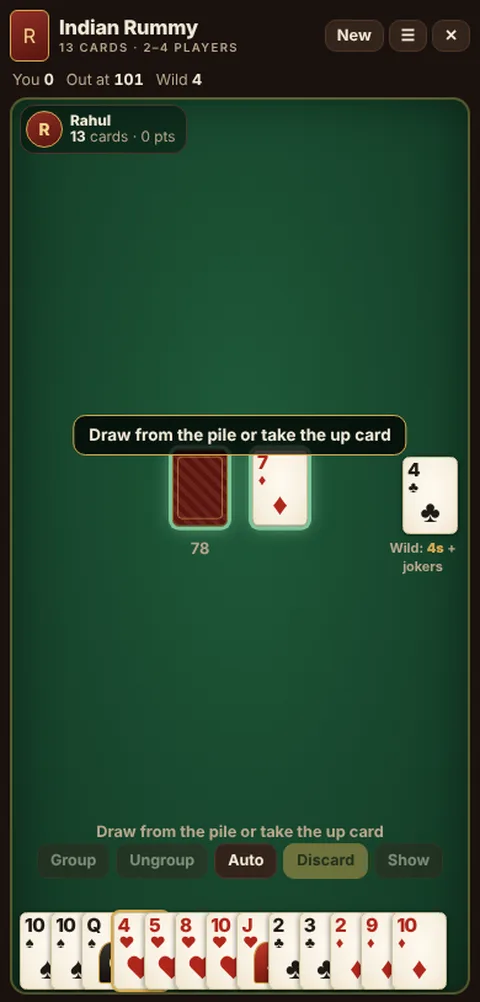
🃏 Play it now (free, no money): open Indian Rummy with 2 to 6 players.
Cards and deal
- Two 52-card packs plus two printed jokers (106 cards).
- Each player is dealt 13 cards. One card is turned face up as the first discard and the rest form the closed pile.
- A card from the pack is cut face up: its rank decides the wild joker for that hand. All cards of that rank and the printed jokers can be used in place of any card.
Melds
- Pure sequence: three or more consecutive cards of the same suit, with no joker or wild card, for example 4♠ 5♠ 6♠. Ace can be low (A-2-3) or high (Q-K-A) but a sequence cannot wrap round (K-A-2).
- Impure sequence: a sequence in which a joker or wild card replaces one or more cards, for example 4♥ 5♥ (joker) 7♥.
- Set: three or four cards of the same rank, all in different suits, jokers allowed. For example 9♠ 9♥ 9♦, or 9♠ 9♥ (joker).
Turns
On your turn, draw the top card of the closed pile or the top card of the discard pile, then discard one card face up. When the closed pile runs out, the discards are shuffled into a new one.
Declaring (showing)
To end the hand your 13 cards (after discarding the 14th) must all be in valid groups, with:
- at least two sequences, and
- at least one of them a pure sequence.
Other groups may be sets or further sequences. Real-money platforms apply an 80-point penalty for a wrong show. Cheettukali only allows Show when your groups are valid, so there is no penalty.
Scoring
- The winner scores 0.
- Others add up the cards that are not in valid melds: Ace, King, Queen, Jack and 10 are 10 points each; 2 to 9 are face value; jokers and wild cards are 0.
- If a player has no pure sequence, all their cards count, up to a maximum of 80.
- A player who drops scores the drop penalty instead: 20 if dropped before the first draw, 40 after (25 and 50 in a 201 game). If only one player is left, they win the hand.
- In a 101 or 201 pool game, a player is out when their total reaches the limit. The lowest total at the end wins.
Example: Your winning 13 cards: 4♠ 5♠ 6♠ (pure sequence), 8♥ 9♥ (joker) (impure sequence), 7♣ 7♦ 7♥ (set), and Q♠ Q♥ Q♦ Q♣ (set). That is two sequences, one of them pure, so you can show.
Strategy tips
- Make your pure sequence first. Without one you cannot show, and a rival's show costs you the maximum.
- Throw away high, unconnected cards early. Kings, Queens and Jacks cost 10 each.
- Keep cards that can work in more than one group, such as 6♠ 7♠ with another 7.
- Use jokers to complete sets and impure sequences, but never rely on them for the pure one.
Variations
- Points Rummy: a single hand, with points as the stake. Pool Rummy (101 / 201): several hands until someone passes the limit. Deals Rummy: a fixed number of hands.
- 21-card rummy is a longer version with three packs and 21 cards per player.
- Drop: you can leave a hand early for a fixed penalty. Cheettukali uses 20 points before your first draw (25 in a 201 game) and 40 (50 in 201) after you have started.
FAQ
Can a joker be in a pure sequence?
No. A sequence containing a joker or the wild-card rank used as a substitute is an impure sequence. Using a wild-rank card in its natural place is allowed in many house rules; Cheettukali treats every wild-rank card as a joker.
How many players can play Indian Rummy?
Two to six players with two packs. Cheettukali has 2 to 6 players with computer opponents.
Is there real money in this game?
No. This is a free game with no deposits, no betting and no prizes.
How does Drop work?
Tap Drop on your turn before drawing to leave the hand. It costs 20 points in a 101 game and 25 in a 201 game if you have not drawn yet, and double that (40 or 50) if you have already started the hand.