Snakes and Ladders Rules
Snakes and Ladders is a race game for two or more players. Move your token from square 1 to square 100, helped by ladders and set back by snakes.
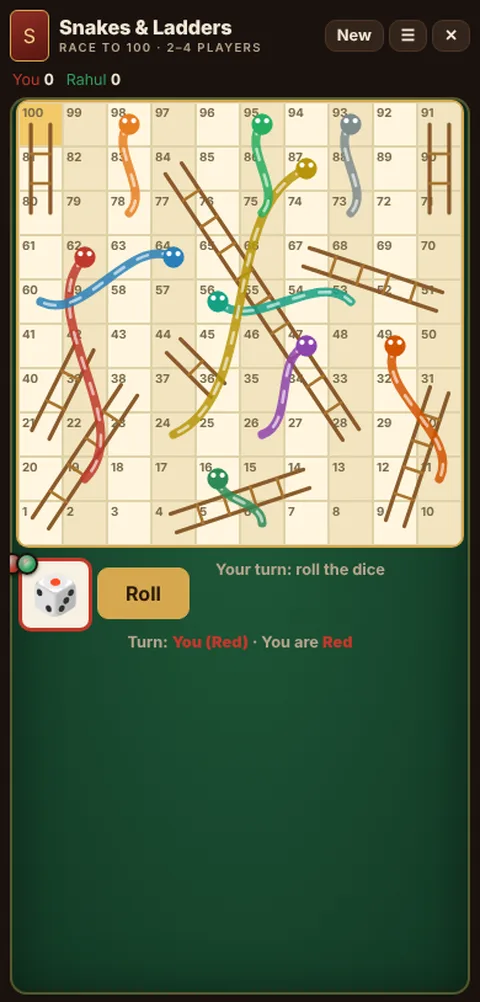
🐍 Play it now: open Snakes and Ladders with 2 to 4 players.
The board
- A square board of 100 numbered squares. Numbers run left to right on the bottom row, then right to left on the next row up, and so on, in a zig-zag, finishing at 100 in the top row.
- Ladders join a lower square to a higher one. Snakes join the square at the head of the snake to a lower square at its tail.
Playing
- Each player has a token and starts off the board.
- In turn, roll one die and move your token that number of squares.
- If you end on the bottom of a ladder, move up to the top. If you end on a snake's head, slide down to its tail.
- Several tokens can be on the same square.
Winning
The first player to land exactly on square 100 wins. If your roll would take you past 100, you do not move that turn. (Some families let you bounce back instead; Cheettukali has this as an option.)
Rolling a 6
In many houses a 6 gives an extra roll. Cheettukali does this by default, and three 6s in a row cancel your turn.
Example: You are on 94 and need a 6 to reach 100. You roll a 3 and move to 97. The next turn you roll a 5: too many, so you stay on 97. Finally you roll a 3 and win.
Cheettukali's board
- Ladders: 1→38, 4→14, 9→31, 21→42, 28→84, 36→44, 51→67, 71→91, 80→100.
- Snakes: 16→6, 47→26, 49→11, 56→53, 62→19, 64→60, 87→24, 93→73, 95→75, 98→78.
History
The game comes from ancient India, where it was called Moksha Patam or Paramapada Sopanam and taught ideas of karma: ladders stood for virtues and snakes for vices. British players brought it home in the 19th century and it became Snakes and Ladders.
Variations
- Bounce back: a roll that overshoots 100 counts the extra steps backwards.
- Exact roll only: the strict rule used by Cheettukali by default.
- Custom boards: families often draw their own snakes and ladders.
FAQ
Can I choose where the snakes go?
Not on Cheettukali, which uses a fixed traditional-style board. On a paper board you can place them anywhere.
What if two players land on the same square?
Nothing special happens. Tokens can share squares and there is no capturing in Snakes and Ladders.
What does Moksha Patam mean?
It is the old Indian name for the game, roughly meaning the ladder to liberation.