56 Card Game Bidding Conventions, Explained
In 56, the bidding is a conversation. Every bid names a number and a suit (or no-trump), and experienced partners use it to tell each other exactly which top cards they hold. Here are the conventions most tables use.
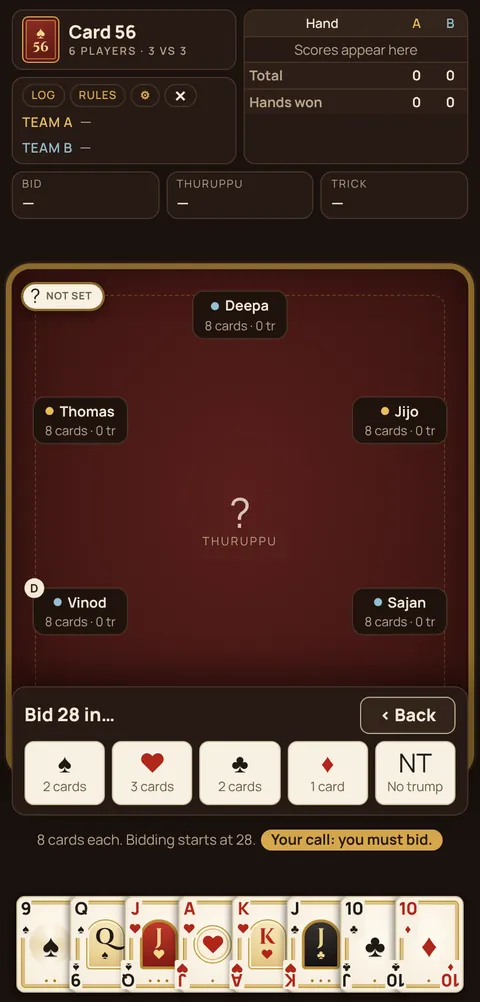
Conventions are agreements, not rules. Your table may differ, and bluffing is part of the game. Agree before you play.
The ground rules
- Bids run from 28 to 56, each higher than the last.
- A bid names a suit or NT (no trump). The final suit becomes the open trump.
- Opponents may double; the bidders may redouble, which usually ends the auction.
Number then suit (e.g. "28 Hearts")
The classic support bid. It says "I hold the top card of this suit". At the lowest level it usually shows the Jack. Jumping higher in the same style shows more top cards.
Suit then number (e.g. "Hearts 28")
Shows length or strength in the suit without the top card. Your partners now know not to count on you for the Jack.
Plus bids (e.g. "Plus One Hearts")
Raise the bid by a stated amount. In many groups "Plus One" in a suit shows the top card alone, without length. Plus bids belong to the more detailed (often called international) style.
NT (no trump)
Shows a strong all-round hand with no outstanding suit, or a wish to play without trumps.
Noes (NS)
Usually means "I have no cards in the suit just bid". A jump in Noes, or "Plus One Noes", can point to a void in an earlier suit instead. Knowing a partner is void tells you who can cut.
Pass bids
A plain pass shows nothing helpful. Some tables let a player pass while raising the level, to keep the bidding alive without showing support. A low "28 pass" from the first bidder often signals a weak hand.
KTC vs ITC styles
Online 56 communities often describe two styles:
| Compare | Kerala style (KTC) | International style (ITC) |
|---|---|---|
| Opening | Lead may open with a pass | Lead must bid at least 28 |
| Plus / reverse bids | Not used; correction bids instead | Used |
| Noes | Covers void and no-trump ideas | Separate NT bid exists |
Scoring reminder
| Bid | Made | Failed |
|---|---|---|
| 28–39 | 1 | 2 |
| 40–47 | 2 | 3 |
| 48–55 | 3 | 4 |
| 56 | 4 | 5 |
Cheettukali's 56 lets you bid any suit or NT freely; the conventions are yours to use. Full rules: 56 card game rules.
A sample auction with conventions
A opens 28 Hearts (I have the J♥). B (opponent) passes. C, A's partner, bids 29 Hearts (I also have a top heart). D passes. E, A's other partner, bids Spades 30 (long spades, but no J♠). Now A knows the team's shape: two top hearts and a long spade suit. A can choose to stay in hearts or switch, based on the rest of the hand.
Without conventions, the same bids would just be numbers. With them, the team builds a picture before a single card is played.
🃏 Try it now: play 56 free in your browser, no download, no money.
FAQ
What does 28 Hearts mean in 56?
Under the usual convention it shows the top card of hearts, normally the Jack.
What is Noes in 56?
A bid that usually shows no cards in the suit just bid, telling partners where you can cut.