56 vs 28: What's the Difference?
56 is often described as 28's bigger, more strategic brother. Here's exactly how they differ.
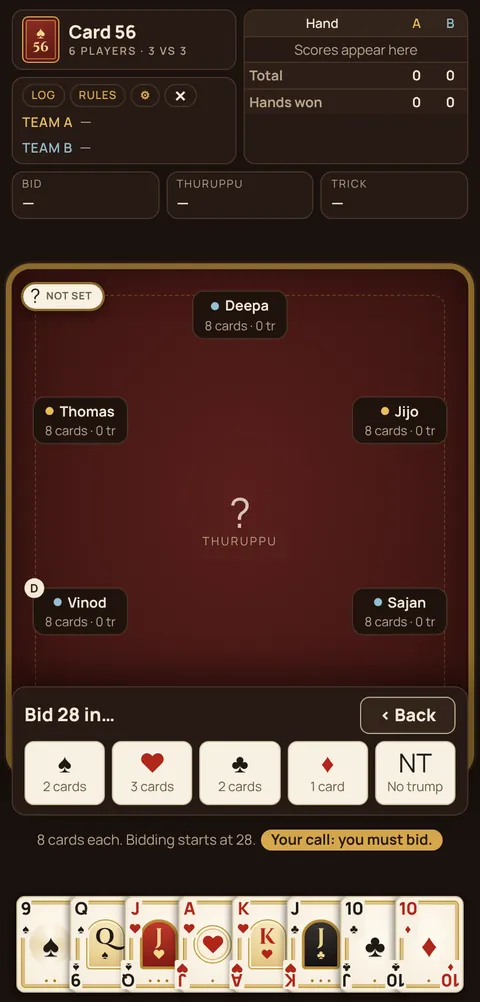
| Compare | 28 | 56 |
|---|---|---|
| Players | 4 (6 in some versions) | 6 (also 4 or 8) |
| Cards | 32, one pack | 48, two packs of J 9 A 10 K Q |
| Points | 28 | 56 |
| Bids | 14–28, a number only | 28–56, number + suit or NT |
| Trump | Hidden face down | Open, named in the bid |
| Bidding as signals | Limited | Central: conventions show top cards |
| Scoring | +1/−2, +2/−3, +3/−4 | 1/2, 2/3, 3/4, 4/5 by bid band |
Which should you play?
- 28 for four players and a faster, livelier game with the drama of the hidden trump.
- 56 for six players who enjoy partnership bidding and deep counting.
Learning path
Most Kerala players learn 28 first, then move to 56 once they can count points comfortably. The skills carry over: ranking, card points, following suit and feeding partners are identical. What's new in 56 is bidding as communication and tracking duplicate cards.
What stays the same
- J, 9, A, 10 carry the points.
- Follow suit; trumps beat other suits.
- Teams win by reaching the bid in points.
What changes
- Trump is open from the start in 56, so there's no "asking for the trump".
- Every card has a twin, and the first one played wins ties.
- Bids carry information, so the auction matters more than in 28.
A side-by-side example
In 28, you might bid 17 with J♥ 9♥ 8♥ K♣ and quietly hide a heart. In 56, the same idea becomes a public statement: "28 Hearts" tells all five other players you hold the top heart, and your two partners plan around it.
That's the real difference: 28 is a game of secrets, 56 is a game of conversation.
🃏 Try it now: play 56 free in your browser, no download, no money.