How to Play Snakes and Ladders: Rules and Variations
Snakes and Ladders needs no skill and no reading, so it is often the first board game a child learns. It is also a very old Indian idea.
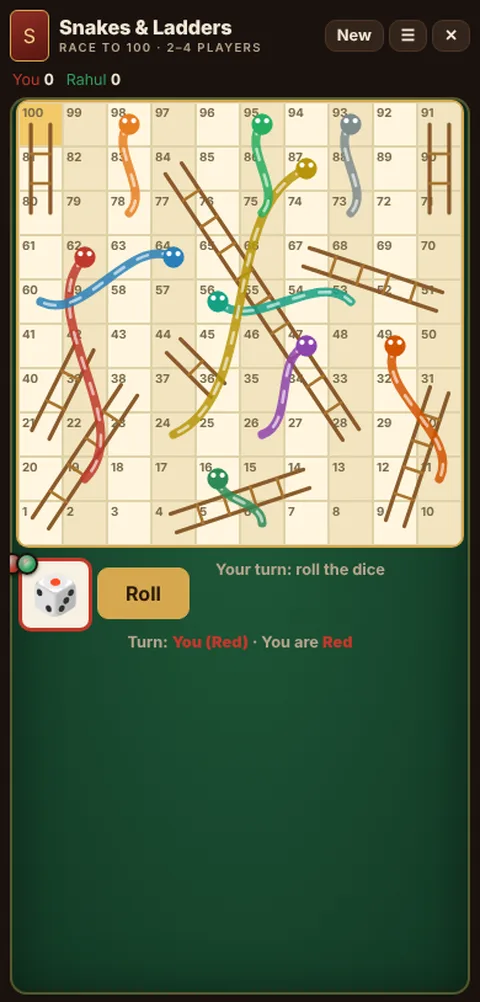
The rules
- Each player puts a token on the start. Everyone takes turns rolling one die.
- Move your token forward by the number rolled, following the numbers from 1 to 100.
- If you land on the foot of a ladder, climb to its top.
- If you land on a snake's head, slide to its tail.
- The first to reach 100 wins. Under the usual house rule you need the exact number to land on 100.
Variations people play
- Extra turn on a 6. Roll again after a six.
- Bounce back. If you roll too high at the end, you move to 100 and back by the extra amount, instead of waiting.
- Need to land exactly. The strictest rule, and the one that makes the end slow and tense.
- Two dice. For a faster game with older children.
Where it comes from
The game is usually traced to ancient India, where it was known as Moksha Patam (also called Paramapada Sopanam). The ladders stood for virtues and the snakes for vices, and the final square meant liberation. It reached Britain in the 19th century and became the board game most people know today. The details of its earliest history are debated, so treat exact dates with care.
Is there any strategy?
No. Your only decisions are the ones you make before the game, such as which variation to use. That is why it suits young children and mixed-age families, and why nobody can say that the other player played better.
You can try it on the free Snakes and Ladders board with 2 to 4 players, and use the menu to turn the exact finish and the extra turn on a 6 on or off.
🃏 Try it now: play Snakes and Ladders free in your browser, no download, no money.
FAQ
Is Snakes and Ladders a game of luck?
Yes, entirely. The die decides every move.
How many squares are on a Snakes and Ladders board?
100, in a 10 by 10 grid.
Do you need an exact number to finish?
In the usual house rule, yes. You can change it in the menu of the online version.
What is Moksha Patam?
The ancient Indian game that Snakes and Ladders is based on. Ladders were virtues and snakes were vices.