29 Hand Examples: What Would You Do?
Rules are easy to read. Judgement comes from seeing hands. Here are six situations with the thinking behind each answer.
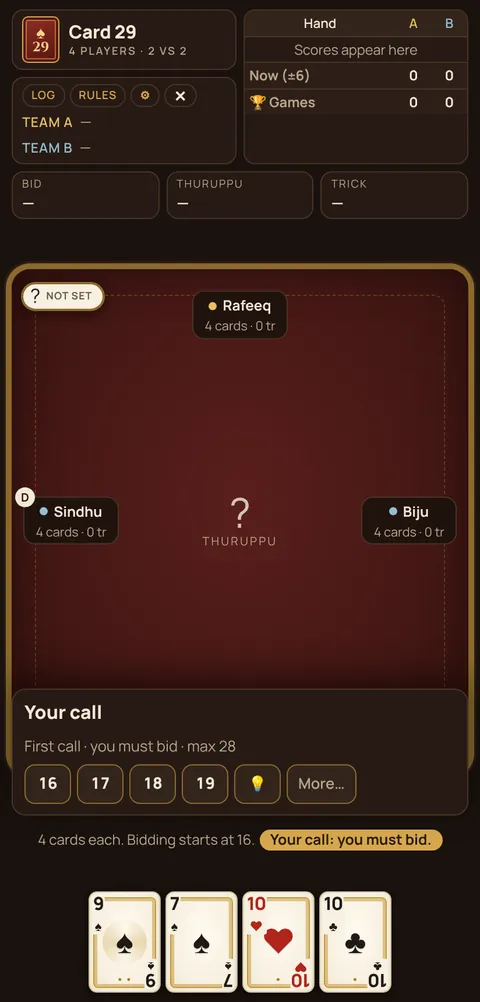
Hand 1: the lonely Ace
Your four cards: A♠ A♥ K♦ 8♣. You are not the opener.
Pass. Two Aces look nice, but each is only the third card in its suit, and you have no Jack and no length.
Hand 2: the classic opener
J♥ 9♥ 7♥ Q♠.
Bid 17–18, hearts as trump. J and 9 of the same suit with a third card is the backbone of a good bid. Hide the 7♥ face down and keep the J and 9 in hand.
Hand 3: two Jacks, no length
J♠ J♦ 10♣ 8♥.
Bid around 17. Two Jacks are strong, but no long suit makes trump choice tricky. If your partner has bid already, support them instead.
Hand 4: to ask or not to ask
Clubs are led: 7♣ from the bidder's partner. You have no clubs. Your partner hasn't played yet.
Usually don't ask. The round has no points so far and your partner may still win it. Throw a low card from a short suit and keep the bidder guessing.
Hand 5: the double
Opponent bid 20 in what looks like spades. You hold J♥ J♦ 9♥ 10♣.
Double. You can see 8 points in two suits the bidder doesn't control. They need 20 of 28; your hand alone makes that very hard.
Hand 6: the Pair bonus
J♣ K♣ Q♣ 9♦.
Bid up to 20 in clubs. You hold the King and Queen of your planned trump. Once you declare the Pair, your target drops by 4.
Test your own judgement with the 💡 Hint button on our table: it shows what the computer would do.
Patterns to take away
- Jacks and length, not scattered Aces, make bids.
- Ask for the trump only when it gains points.
- Double with points you can see, not with hope.
- A likely Pair lets you bid about 4 higher.
🃏 Try it now: play the 29 card game free in your browser, no download, no money.