How to Bid in the 29 Card Game
Most hands of 29 are won or lost in the bidding. Bid too low and you hand the game to the other side; bid too high and your partner has to perform miracles. Here is a simple way to judge your four cards.
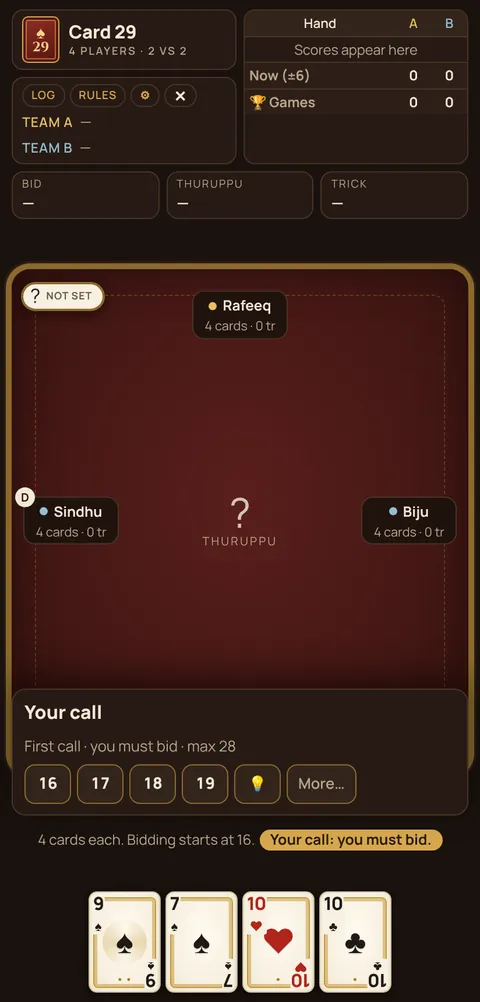
Step 1: look for Jacks
A Jack is the top card of its suit and worth 3 points. One Jack is the minimum reason to bid seriously. Two Jacks, especially in the same suit as other cards, make you a strong bidder.
Step 2: look for length
Length means holding several cards of one suit. Three or four cards of a suit, with the Jack or Nine among them, make that suit a good trump. A long trump suit wins rounds late in the hand, after the big cards are gone.
Step 3: add your partner's share
You are bidding for the team. On average your partner's eight cards will hold about 7 points, and you will win some extra points from the opponents' cards. A rough guide many players use:
| Your four cards | Typical bid |
|---|---|
| No Jack, scattered cards | Pass (or the forced minimum if you must open) |
| One Jack plus two more of that suit | 16–17 |
| J + 9 of the same suit, plus one more | 17–18 |
| Two Jacks, one of them with length | 18–20 |
| Three Jacks, or J-9-A of one suit plus a Jack | 20 and above |
These are starting points, not laws. Table style matters: some groups bid aggressively, others carefully.
Step 4: think about the Pair
If you hold the King and Queen of your intended trump suit, you have a likely Pair. Once declared, it lowers your target by 4. That means you can bid up to 4 higher than your cards alone justify, as long as you are sure you'll get to declare it.
Step 5: listen to the others
If an opponent bids high, they probably hold Jacks. If your partner bids, they have something too, so you can support with less. If both opponents keep raising each other, let them: a pass is often the best bid.
The classic beginner mistake
Bidding on high cards in four different suits. Four Aces look strong in rummy, but in 29 an Ace is the third-best card of its suit. Without length or Jacks, those Aces get eaten by Nines and Jacks.
Practise without pressure
The fastest way to learn bidding is to play many hands. On Cheettukali you can use the 💡 Hint button during bidding to see what the computer would bid, and Undo if you tapped the wrong number.
A worked auction
North (opener) bids 16 with a J♠ and two small spades. East passes. South, North's partner, holds J♥ 9♥ A♥ K♣ and bids 18 over partner. West bids 19. North passes. South thinks: "My hearts are solid and partner has spades; 20 is fine." South bids 20, everyone passes, and South hides a low heart.
Notice how South used the partner's opening bid as information. That's bidding as a team.
🃏 Try it now: play the 29 card game free in your browser, no download, no money.
FAQ
What is a good opening bid in 29?
With one Jack and some length in that suit, 16 or 17 is normal. Without a Jack, pass unless you are forced to open.
Can I bid over my partner in 29?
Yes, in 29 you may bid over your partner at any level, unlike 28 where you need 20.